Monday, December 11, 2006

Reasonable Success
My final project, hastily dubbed "Penance", was screened in class today and well...it was received fairly well--that is, with less negativity than my last two. And furthermore, there were a few people who went out of their way to "Congrat" me after class, which was pretty cool even if I didn't know what to say. It was probably for just not sucking as much as they thought I would (modesty or Soderbergian modesty?).
I'm glad it's finally time for a break, although apparently Noel will sending out next quarter's first assignment sometime next week so that we can get a head start on it. Oh well. Couldn't hurt I suppose. And as much as I enjoy a good break, I was left in a unique situation after this last project, one I haven't been in since, well, ever: despite the massive amount of effort I put into Penance, the many, many sleepless nights, the logistical stress, the 5-day shoot, the four hours of rehearsals, the unending etc.'s amidst my other obligations, I completed this project wanting and ready to make the next. Usually when I'm done, I feel like I'm never going to want to make another short again. Not so this time. It was probably a combination of the great experience I had with this one, the feeling of (mostly) satisfaction, and the personal commitment I made to the project, the personal stakes. In the past, I've felt like I've been committed, like staying up all night is "commitment", but now I realize what was really going on was a desire to be committed. I wasn't actually. And that was reflected in my inability to make sound creative decisions and turn over a unified work.
There are a few things I gleaned from the critique:
1) I need to do a cost-benefit analysis of the film's visual quality vs. its story Quality. There has to be a balance between the two. Tip the scales too far in either direction, and you're going to end up with a wildly uneven film. One should not be sacrificed for the other.
2) Everyone's specific behaviors influenced the making/structuring/playing of your films in very specific ways.
3) Seeing the character's face made him human, showed that he wasn't a superman. Allowed audience to relate to him better.
4) "NO" was too much. We were already thinking that in our heads that killing is wrong. I don't need to tell them.
5) Removing the narration was like dodging a massive bullet. It strengthened the film: addition by subtraction.
6) "Balls" not necessary. Be mindful of the highly masculine environment associated with the military: saying "them" would have been enough.
7) Learn how to give us more without giving us more.
8) Because I'm a veteran, my audience trusts my authority on the subject matter, but if I go to far illustratively, I lose their trust in my authority. It's a fine line I have to walk, between talking down to my audience and not giving them enough information to interpret a world they may not be familiar with.
I'm fairly proud of the finished product. I think for the first time this quarter, I made the best possible product I could given the assignment, time constraints, available equipment, and where I am in my emotional/intellectual/creative growth. The two things that really pleased me to hear during crit were Shawn's two remarks about a) Jan's performance, how nuanced and particular every stutter and glance was, and the associated implications (meaning the 4-5 hrs. of rehearsal and 20+ takes paid off--although I'm not sure if anyone else caught on to the subtext); and b) that my film is "deeply disturbing"--the closest thing to a straight-up compliment I think I've yet gotten from Shawn, and possibly anyone, so far this year.
Listening to: Yeah Yeah Yeahs
Going to watch later: Deadwood Season 2 eps. 6+
I'm glad it's finally time for a break, although apparently Noel will sending out next quarter's first assignment sometime next week so that we can get a head start on it. Oh well. Couldn't hurt I suppose. And as much as I enjoy a good break, I was left in a unique situation after this last project, one I haven't been in since, well, ever: despite the massive amount of effort I put into Penance, the many, many sleepless nights, the logistical stress, the 5-day shoot, the four hours of rehearsals, the unending etc.'s amidst my other obligations, I completed this project wanting and ready to make the next. Usually when I'm done, I feel like I'm never going to want to make another short again. Not so this time. It was probably a combination of the great experience I had with this one, the feeling of (mostly) satisfaction, and the personal commitment I made to the project, the personal stakes. In the past, I've felt like I've been committed, like staying up all night is "commitment", but now I realize what was really going on was a desire to be committed. I wasn't actually. And that was reflected in my inability to make sound creative decisions and turn over a unified work.
There are a few things I gleaned from the critique:
1) I need to do a cost-benefit analysis of the film's visual quality vs. its story Quality. There has to be a balance between the two. Tip the scales too far in either direction, and you're going to end up with a wildly uneven film. One should not be sacrificed for the other.
2) Everyone's specific behaviors influenced the making/structuring/playing of your films in very specific ways.
3) Seeing the character's face made him human, showed that he wasn't a superman. Allowed audience to relate to him better.
4) "NO" was too much. We were already thinking that in our heads that killing is wrong. I don't need to tell them.
5) Removing the narration was like dodging a massive bullet. It strengthened the film: addition by subtraction.
6) "Balls" not necessary. Be mindful of the highly masculine environment associated with the military: saying "them" would have been enough.
7) Learn how to give us more without giving us more.
8) Because I'm a veteran, my audience trusts my authority on the subject matter, but if I go to far illustratively, I lose their trust in my authority. It's a fine line I have to walk, between talking down to my audience and not giving them enough information to interpret a world they may not be familiar with.
I'm fairly proud of the finished product. I think for the first time this quarter, I made the best possible product I could given the assignment, time constraints, available equipment, and where I am in my emotional/intellectual/creative growth. The two things that really pleased me to hear during crit were Shawn's two remarks about a) Jan's performance, how nuanced and particular every stutter and glance was, and the associated implications (meaning the 4-5 hrs. of rehearsal and 20+ takes paid off--although I'm not sure if anyone else caught on to the subtext); and b) that my film is "deeply disturbing"--the closest thing to a straight-up compliment I think I've yet gotten from Shawn, and possibly anyone, so far this year.
Listening to: Yeah Yeah Yeahs
Going to watch later: Deadwood Season 2 eps. 6+
Wednesday, December 06, 2006
Day of the Triffids
The Triffids were an awesome, post-Invaders from Mars, post-War of the Worlds apocalyptic species of alien; they were also kind of a pre-cursor to Invasion of the Body Snatcers--two subgenres of science fiction genre they were able to straddle because they were definitely an alien race intent on the complete and utter destruction of mankind! but also because they looked like trees so we couldn't tell they were aliens! until they started attacking! and then they were invincible! almost impervious to weaponry! until someone sprayed them with salt water and they melted faster than the Wicked Bitch of the East in That Wuss of Oz. 'Cept not the HBO. Not that I ever liked that show. I'm a DWood / Entourage / Wire kind of fella when it comes to HBO...
The day of the triffids. The Day of the Triffids.
I have a triffid infestation on my hands and I desperately need some saltwater.
Triffid: I am implicitly charged with finding a creative way to use the black void / Monolith-ic objects that now inhabit my short film in place of the chroma keyed greenscreen and the black horizon that is matting-out the Sound and Olympic Peninsula. I had originally planned to put found footage of Iraqi children in there, but after some guidance from Noel, the resulting look of the keying minus the footage is pretty spectacularly unsettling. He thinks there's an opportunity to capitalize on imcorporating an unforseen-albeit-awesome image that totally renegotiates the filmic space.
Saltwater: I think the best way to go about incorporating and clarifying the "running toward the void"--which is what this now is--is to use completely re-written narration. Currently, I only have a few lines at the beginning and the end, but I think if I expand on what I have already and construct more of a meditation on taking a human life--child or not--it ought to fit in nicely. The narration is the most influential part that I have yet to lock-down, so that's probably the most effective way of bringing the void in.
It'd be nice to take the title from a Nietzche quote. That might be too heavy-handed though.
As for the rest, there are moments that look pretty friggin' spectacular (compared to my past work), but it's in the editing I do in the next few hours and the audio work I do tomorrow that will make or break this sonuvabitch.
Listening to: The Departed Tango
Not Watching: The Day of the Triffids because THEM! busts so much more ass
The day of the triffids. The Day of the Triffids.
I have a triffid infestation on my hands and I desperately need some saltwater.
Triffid: I am implicitly charged with finding a creative way to use the black void / Monolith-ic objects that now inhabit my short film in place of the chroma keyed greenscreen and the black horizon that is matting-out the Sound and Olympic Peninsula. I had originally planned to put found footage of Iraqi children in there, but after some guidance from Noel, the resulting look of the keying minus the footage is pretty spectacularly unsettling. He thinks there's an opportunity to capitalize on imcorporating an unforseen-albeit-awesome image that totally renegotiates the filmic space.
Saltwater: I think the best way to go about incorporating and clarifying the "running toward the void"--which is what this now is--is to use completely re-written narration. Currently, I only have a few lines at the beginning and the end, but I think if I expand on what I have already and construct more of a meditation on taking a human life--child or not--it ought to fit in nicely. The narration is the most influential part that I have yet to lock-down, so that's probably the most effective way of bringing the void in.
It'd be nice to take the title from a Nietzche quote. That might be too heavy-handed though.
As for the rest, there are moments that look pretty friggin' spectacular (compared to my past work), but it's in the editing I do in the next few hours and the audio work I do tomorrow that will make or break this sonuvabitch.
Listening to: The Departed Tango
Not Watching: The Day of the Triffids because THEM! busts so much more ass
Tuesday, December 05, 2006
Rendered Notes
A sampling of the lovely post-production tasks left to complete if my final project for this quarter is to be anything near as good as it is in my head (as of 1.46 am on 06DEC06):
1) Lock edit
2) Greenscreen keying -- Matte, single frames
3) Find found footage -- probably not necessary
4) Write new narration
5) Clean nat audio -- Low Pass/High Pass
6) Audio effects list
7) ADR and Foley
8) Color Correction
9) Title/Credits
Italics = Finished
Listening to: The Chud Show episode 17
1) Lock edit
2) Greenscreen keying -- Matte, single frames
3) Find found footage -- probably not necessary
4) Write new narration
5) Clean nat audio -- Low Pass/High Pass
6) Audio effects list
7) ADR and Foley
8) Color Correction
9) Title/Credits
Italics = Finished
Listening to: The Chud Show episode 17
Friday, December 01, 2006
Bloody Frozen Frame
I don't think this will appear in the short looking exactly like this--meaning, I don't think I'll be having any freeze-frames--but I thought this looked fucking awesome in all its motion blur, low resolution, eye-drooping, looking-into-the-camera glory, so here it is:

Writing: Final fucking essay

Writing: Final fucking essay
Wednesday, November 29, 2006
Possible Solution(s)
Instead of finding an Iraqi boy/actor, find found footage and comp it in over a screen that the character is running towards in the snowy desert!!! This could kickass: Found footage. Cut back to reveal screen in desert. Cut to running or if possible, pull-focus. Shoot with pull focus and without! identifiable color other than white. Use black stuff? Get blue paint?
And try to comp in "killing sucks" interview during mirror scene. If not, then at least the audio, sounding all recycled and shit. And get a shot tonight of the tank to take to class tomorrow. Remember to get silence in the space. Remember to get close-up on hand before completely taking down set.
And try to comp in "killing sucks" interview during mirror scene. If not, then at least the audio, sounding all recycled and shit. And get a shot tonight of the tank to take to class tomorrow. Remember to get silence in the space. Remember to get close-up on hand before completely taking down set.
Day 1 Down, 2 to Go
 Day One of shooting for my final project this quarter is over--and I'm nowhere near as glad as I'm sure my lead actor, Jan, is. Poor motherfucker has to start his mail route at 7 this morning, but he leaves at 6 for it...and we didn't wrap until 245am.
"Perfectionism" is a curse and a blessing--but if that's true, then why haven't my films gelled so far? I've sure put the effort into them, but there are no A's for effort. It's what's on the screen that matters, not what'snot--unless that's the point, but that's besides the point. O
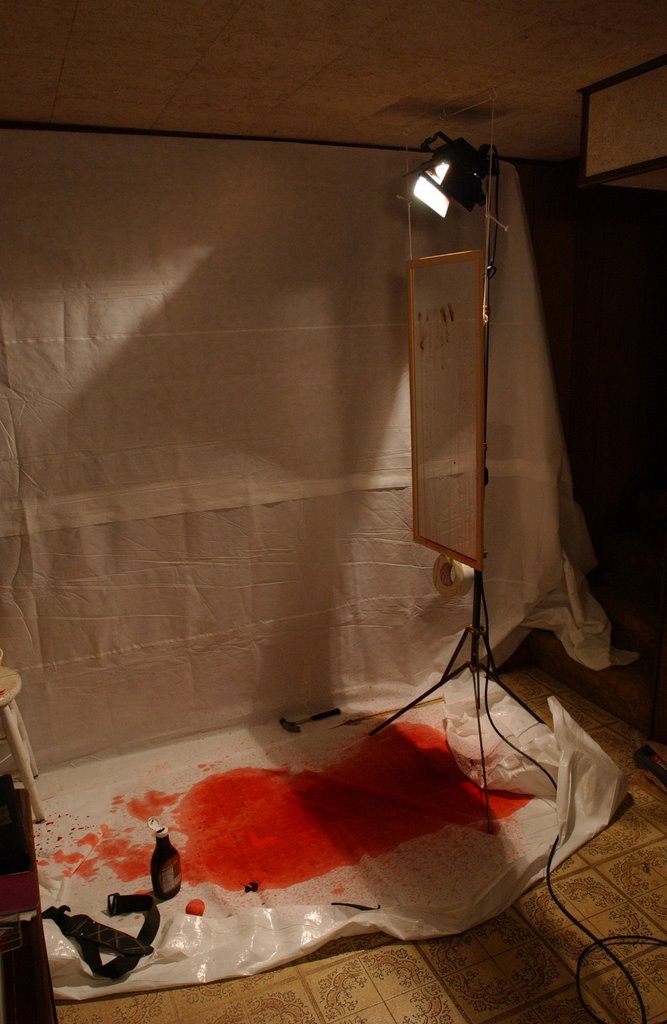 ne thing I've realized about my sense of "perfectionism" is that I do and do and do and do and it still seems like I never quite get the things I want to get right, right. I think in the moment, I just need to push forward and that if I persevere, I'll make it through the other side. But something I'd like to start teaching myself to do is to realize what it is that isn't working, not just my gut feeling, and taking the time to pause and solve the problem before repeating the take. I could tell Jan was getting testy with me, and I don't blame him. I just hope I don't let him down and the massively unnecessary time committment he put into this thing. I almost don't even care if I let myself down, just as long as I do justice to the effort he put into the thing.
Of course, I hope that by doing justice to his effort, I will do right by my own.

About to be Watching: Apocalypse Now
But still Listening to: The Fountain soundtrack
Tuesday, November 28, 2006
More notes...
1) No bloody rictus? Eyes closed? Surgeon's mask on? Film several different ways. Don't have to do tracking shot repeatedly, just frame it so that his face isn't seen.
2) If the "INVALID" moment is taken out, what is going to be the transition tool? Just transitioning from real-time laughter doesn't strike as being quite as effective. Maybe he doesn't scream into the camera, maybe it's only a whisper, a nearly subliminal whisper.
2) If the "INVALID" moment is taken out, what is going to be the transition tool? Just transitioning from real-time laughter doesn't strike as being quite as effective. Maybe he doesn't scream into the camera, maybe it's only a whisper, a nearly subliminal whisper.
Monday, November 27, 2006
A few notes...
...
1) I just remembered last night as I was falling asleep, that it was the summer I turned 20, not the summer I turned 19.
2) My girlfriend really detested the INVALID part--like, literally, detested it. I'll probably end up axing it, since it's not absolutely necessary and it seems to be more alienating than I really wanted it to be. Jarring, not alienating. I don't want to be hated for rubbing peoples noses in filth. I just want to construct a space that conveys my confusion, anger and cynicism at not only being faced with that decision but that I was lead to believe that I had to do something like it to be a "man".
3) I may change the "no man" writing on the mirror to "fuck this" and move that through-the-mirror shot closer to the end, to replace the close-up on the lips of the "fuck this". That'd further link the spaces together I think, establishing that all that was really what went through the character's head as he was faced with the decision. The other bonus is that it may heighten the suspense by stretching out the running segment--it would at least be closer to the motif Noel suggested. On the other hand, it may totally defuse the tension--I don't think it would; it's prolonging the moment, therefore it should be increasing the tension, as tension is derived from a suspension of resolution over time. I think I just paraphrased Hitchcock, but I'm not sure. On the other hand, since I've led the viewer to believe that they may already know the outcome, there may not be any tension at all...I think because I'm flashing back to the event in medias res, before it's happened, there will be more tension because they already know what's going to happen and maybe now they're afraid they're going to see it?
4) The "fuck this" I want to be carthartic. Cathartic with the realization that I didn't actually choose that path. I want it to feel good to hear that line, to realize that I didn't kill the boy. Using the testicle scene might, again, be too alienating to effectively communicate this. But it's a nice goddamn image...I suppose what I could do is use that as a back up if Jan won't be able to make it to the exterior shooting, but if he is able to, I'll film both and see which works better.
Listening to: The Fountain soundtrack
1) I just remembered last night as I was falling asleep, that it was the summer I turned 20, not the summer I turned 19.
2) My girlfriend really detested the INVALID part--like, literally, detested it. I'll probably end up axing it, since it's not absolutely necessary and it seems to be more alienating than I really wanted it to be. Jarring, not alienating. I don't want to be hated for rubbing peoples noses in filth. I just want to construct a space that conveys my confusion, anger and cynicism at not only being faced with that decision but that I was lead to believe that I had to do something like it to be a "man".
3) I may change the "no man" writing on the mirror to "fuck this" and move that through-the-mirror shot closer to the end, to replace the close-up on the lips of the "fuck this". That'd further link the spaces together I think, establishing that all that was really what went through the character's head as he was faced with the decision. The other bonus is that it may heighten the suspense by stretching out the running segment--it would at least be closer to the motif Noel suggested. On the other hand, it may totally defuse the tension--I don't think it would; it's prolonging the moment, therefore it should be increasing the tension, as tension is derived from a suspension of resolution over time. I think I just paraphrased Hitchcock, but I'm not sure. On the other hand, since I've led the viewer to believe that they may already know the outcome, there may not be any tension at all...I think because I'm flashing back to the event in medias res, before it's happened, there will be more tension because they already know what's going to happen and maybe now they're afraid they're going to see it?
4) The "fuck this" I want to be carthartic. Cathartic with the realization that I didn't actually choose that path. I want it to feel good to hear that line, to realize that I didn't kill the boy. Using the testicle scene might, again, be too alienating to effectively communicate this. But it's a nice goddamn image...I suppose what I could do is use that as a back up if Jan won't be able to make it to the exterior shooting, but if he is able to, I'll film both and see which works better.
Listening to: The Fountain soundtrack
A Script--finally!
I finally finished the script for my final project. Right now its tentatively titled "The Summer I Turned 19 by Erik LeDrew" and is, as I said before, about that moment in Iraq, the summer I turned 19.
I feel like this is the most coherent and, hopefully, meaningful thing I've done so far. The only thing I've written, extracurricular or otherwise, that feels like it could be mentioned in the same sentence is "bruiser". I don't know what else to say about it except that it's ambitious but intimate and I don't think I've set up any obstacles for myself that are impossible to overcome.
The obstacle that I couldn't find a solution for--and at this point, I'm not sure I want to--was properly integrating Noel's suggestion to have a recurring image of kinetic motion placed through the short to give a feeling of gathering momentum, building toward something. I tried to adapt the image of the Soldier running in the desert to his idea of a speeding motorcycle, but it felt too inorganic plunking it down in the middle of the mess. The shot works better as the bookends. And the besides, the two middle segments flow so smoothly into each other, that I didn't want to interrupt that--but maybe that's my recurring problem coming back to haunt me again, being married to the concept--except I can't exactly be married to it, when the solution I came up with to link the interview segment and the operating room segment was not one of my pre-dispositions. I had originally envisioned a post-modern mess of jump-cuts like a Rob Zombie or Marilyn Manson music video. I think what I came up with is far more organic (structurally inspired by Eraserhead, appropo) to the narrative and much more elegant.
Any problems I'd venture to guess at are probably not the ones people will hit on, but to try: it's possible the testicle writing is a bit too extraneous. But I'm angry and cynical and I think it's a shock that needs to stay put. The one "shock" that I can see parting with is the doctor yelling "INVALID" into the camera. That is a concept that is revealed aplenty in the operating room sequence and the writing on the mirror. It works for effect, to jarr the audience and hints that the doctor is "punishing" the Soldier, not condoning. But nevertheless, it is the most like the shock editing I'm so afraid of and is the part that I could easily see losing without too much damage being done to the rest of the short.
Filming is Tuesday and Wednesday, with pickups and ADR scheduled for the following Tuesday. And the desert shooting scheduled whenever Jan is available to head east of the mountains--weather, goddammit, permitting.
Listening to: The Departed soundtrack
I feel like this is the most coherent and, hopefully, meaningful thing I've done so far. The only thing I've written, extracurricular or otherwise, that feels like it could be mentioned in the same sentence is "bruiser". I don't know what else to say about it except that it's ambitious but intimate and I don't think I've set up any obstacles for myself that are impossible to overcome.
The obstacle that I couldn't find a solution for--and at this point, I'm not sure I want to--was properly integrating Noel's suggestion to have a recurring image of kinetic motion placed through the short to give a feeling of gathering momentum, building toward something. I tried to adapt the image of the Soldier running in the desert to his idea of a speeding motorcycle, but it felt too inorganic plunking it down in the middle of the mess. The shot works better as the bookends. And the besides, the two middle segments flow so smoothly into each other, that I didn't want to interrupt that--but maybe that's my recurring problem coming back to haunt me again, being married to the concept--except I can't exactly be married to it, when the solution I came up with to link the interview segment and the operating room segment was not one of my pre-dispositions. I had originally envisioned a post-modern mess of jump-cuts like a Rob Zombie or Marilyn Manson music video. I think what I came up with is far more organic (structurally inspired by Eraserhead, appropo) to the narrative and much more elegant.
Any problems I'd venture to guess at are probably not the ones people will hit on, but to try: it's possible the testicle writing is a bit too extraneous. But I'm angry and cynical and I think it's a shock that needs to stay put. The one "shock" that I can see parting with is the doctor yelling "INVALID" into the camera. That is a concept that is revealed aplenty in the operating room sequence and the writing on the mirror. It works for effect, to jarr the audience and hints that the doctor is "punishing" the Soldier, not condoning. But nevertheless, it is the most like the shock editing I'm so afraid of and is the part that I could easily see losing without too much damage being done to the rest of the short.
Filming is Tuesday and Wednesday, with pickups and ADR scheduled for the following Tuesday. And the desert shooting scheduled whenever Jan is available to head east of the mountains--weather, goddammit, permitting.
Listening to: The Departed soundtrack
Tuesday, November 21, 2006
Alternative History Vol 1 - Shock Editing and Me
So the next project, the final for this quarter, the third of the sequence, is that we have to envision some sort of alternative history of a moment in our lives. It has to be autobiographical and must be between 3 and 5 minutes.
So with that said, I've pretty much narrowed down the kernal of the idea down to the moment that I came closest to shooting somebody in Iraq--and it turned out to be a boy who couldn't be more than 8. The alternative history will be...the obvious. "What if" I had actually pulled the trigger...?
Now, I don't want it to be as emotionally obvious as that premise could be--guilt, self-medication, etc. I'm more cynical than that, and I'd be selling myself out if my next project didn't reflect my cynicism.
I've laid out a few aesthetic no-go's that will hopefully guide my hand through the rest of the ideation and into and through shooting and editing.
1. No jump cuts
2. As few shock edits as possible (ie - abusing Soviet montage)
3. No match-cut reliance
4. Nothing, nothing random (this is actually already a guideline, but I want to remind myself to control completely everything in and out of the frame)
5. If possible, no explicitly Army, Iraq, U.S. imagery
The first problem I'm encountering in my ideation is that I can't imagine this done in any ways other than through jump cuts and shock edits.
challenge #1: Find a way to either a) Construct the filmic imagery without shock editing, or b) Find a more creative/organically evolving way to use shock editing/jump cuts.
The issue with shock editing is that there is no realistic way that that style can carry a whole film, 3 minutes or 90 minutes. It would get stale and tepid very, very quick. Unless, perhaps, the imagery itself can be enough to sustain an audience's attention, even with spastic, rapid-fire editing. The other problem with a barrage of shock edits is that I'm just plain tired of it. Not a single short film I've yet made has been without shock editing.
Am I truly a product of the MTV-generation?
I supposed I just don't grasp narrative storytelling enough to construct a non-invasive scene quite yet. Am I giving in already? I'll see what my compadres have to say about it tomorrow.
Watching: Eraserhead
So with that said, I've pretty much narrowed down the kernal of the idea down to the moment that I came closest to shooting somebody in Iraq--and it turned out to be a boy who couldn't be more than 8. The alternative history will be...the obvious. "What if" I had actually pulled the trigger...?
Now, I don't want it to be as emotionally obvious as that premise could be--guilt, self-medication, etc. I'm more cynical than that, and I'd be selling myself out if my next project didn't reflect my cynicism.
I've laid out a few aesthetic no-go's that will hopefully guide my hand through the rest of the ideation and into and through shooting and editing.
1. No jump cuts
2. As few shock edits as possible (ie - abusing Soviet montage)
3. No match-cut reliance
4. Nothing, nothing random (this is actually already a guideline, but I want to remind myself to control completely everything in and out of the frame)
5. If possible, no explicitly Army, Iraq, U.S. imagery
The first problem I'm encountering in my ideation is that I can't imagine this done in any ways other than through jump cuts and shock edits.
challenge #1: Find a way to either a) Construct the filmic imagery without shock editing, or b) Find a more creative/organically evolving way to use shock editing/jump cuts.
The issue with shock editing is that there is no realistic way that that style can carry a whole film, 3 minutes or 90 minutes. It would get stale and tepid very, very quick. Unless, perhaps, the imagery itself can be enough to sustain an audience's attention, even with spastic, rapid-fire editing. The other problem with a barrage of shock edits is that I'm just plain tired of it. Not a single short film I've yet made has been without shock editing.
Am I truly a product of the MTV-generation?
I supposed I just don't grasp narrative storytelling enough to construct a non-invasive scene quite yet. Am I giving in already? I'll see what my compadres have to say about it tomorrow.
Watching: Eraserhead
Monday, November 20, 2006
Nightmares and Dreamscapes
So I've been meaning to blog about this because I think it's pretty indicative in the Freudian sense of how mentally and emotionally overwhelming this video sequence is becoming.
It was last Friday night I think, that I had a nightmare about being in my DXARTS class. All eyes were on me, I especially remember Noel (my instructor) staring with waiting, expectant eyes, as I was being asked why I couldn't finish my project. I don't think it was necessarily the next project, but it definitely wasn't like I was re-imagining a critique of one of my past ones.
Anyhow, as I'm sure you know if you've been reading my past blogs, I've been pretty negatively critiqued for making certain mistakes...and then making them again. And in this critique, I was being criticized because I was unable to follow-through on my project, almost as if I was missing a last act, like I couldn't quite come through on it.
It felt like the class was asking me to finish the film right then and there, and I couldn't, for whatever reason. I was feeling this immense pressure and I had director's block, I simply couldn't preform. I felt frozen in place, as if I had stage fright. They were pressing me, asking, "Why can't you just finish it?" And I didn't know what to tell them. I just couldn't imagine anything. It was a blank slate. And futhermore, I didn't know what to say. I was dumbfounded, unable to perform, unable to respond.
It's pretty obvious that I'm feeling insecure, and probably more than a little infertile (figuratively speaking). I'm surprised I didn't have a truly Freudian nightmare about being unable to perform during sex. But this was close enough, and more situationally specific anyways. There are no answers within this dream, just a more stark evocation of feelings I already feel.
I don't know what this adds to the internal discourse on my abilities and shortcomings, but if nothing else, at least I know I'm emotionally and intellectually invested enough in this class that I can have nightmares about it. Awesome!
It was last Friday night I think, that I had a nightmare about being in my DXARTS class. All eyes were on me, I especially remember Noel (my instructor) staring with waiting, expectant eyes, as I was being asked why I couldn't finish my project. I don't think it was necessarily the next project, but it definitely wasn't like I was re-imagining a critique of one of my past ones.
Anyhow, as I'm sure you know if you've been reading my past blogs, I've been pretty negatively critiqued for making certain mistakes...and then making them again. And in this critique, I was being criticized because I was unable to follow-through on my project, almost as if I was missing a last act, like I couldn't quite come through on it.
It felt like the class was asking me to finish the film right then and there, and I couldn't, for whatever reason. I was feeling this immense pressure and I had director's block, I simply couldn't preform. I felt frozen in place, as if I had stage fright. They were pressing me, asking, "Why can't you just finish it?" And I didn't know what to tell them. I just couldn't imagine anything. It was a blank slate. And futhermore, I didn't know what to say. I was dumbfounded, unable to perform, unable to respond.
It's pretty obvious that I'm feeling insecure, and probably more than a little infertile (figuratively speaking). I'm surprised I didn't have a truly Freudian nightmare about being unable to perform during sex. But this was close enough, and more situationally specific anyways. There are no answers within this dream, just a more stark evocation of feelings I already feel.
I don't know what this adds to the internal discourse on my abilities and shortcomings, but if nothing else, at least I know I'm emotionally and intellectually invested enough in this class that I can have nightmares about it. Awesome!
Thursday, November 16, 2006
My girlfriend left me a very encouraging message on my phone earlier. She seems to think that I need to stop thinking of myself as an artist creating art, and more as a student learning artistry. This could be part of the issue. I don't approach my assignments as learning opportunities but rather as another chance to show up my classmates and teachers--show them that the tens of thousands of hours I've spent watching movies, the essays, the lectures, the books, the DVD hyper-extended features...that I "know" what I'm doing. And I think I'm taking the competition thing way too seriously. My sensibilities are vastly different from the rest of the class, as many of them are from each other. And yet, I endlessly compare my shit to theirs...goddamn comparative literature. My first instinct isn't to work my heart out and push it to mental, emotional, psychological failure, but to find a measuring stick against which to measure myself, and then strive to measure up. And I'm a talker, so if the work itself doesn't actually measure up, I can at least talk part of the way up the stick.
This is not good.
This is not good.
I got railed again today. Not hit as hard as last time though, partially because I'm becoming numb to criticism (which is good, as long as I don't go over the line and just disregard it completely) and partially because I made exactly the same mistakes as I did before and had the same sucesses as before. There's nothing more boring than redundancy. It makes me wonder if I've grown at all as an artist, from the first assignment to this second one. Have I? I don't know. Maybe I have and I'm only insecure now because I can't handle crit very well and I let the criticisms of my work go to my head. But I am my work. I lack progressive work because I don't understand myself well enough to be able to challenge my strengths and nurture my weaknesses...I even wonder if I should be in this class. I was talking with someone after class, and he pointed out to me that he's had a lot of training with all of the different tools that we're bringing to bear on our work in 45x, and he sees this sequence as the capstone to that, where he gets to refine what he's learned. I'm not in that same position. I am learning as I go. I'm not able to take what I already know and bring it a step further...at least, not technically. I suppose, I am bringing what I know...theory and history, criticism, crossed with a writing/photographic background...and am trying to refine it into cinema. I suppose in some ways its working, but I'm still finding myself having to shit out critical thought. I need to train myself to be able to switch effortlessly from intuition to criticism whenever I desire. When I acheive that, maybe I'll be able to recognize a bad idea a helluva lot easier. Like, as-soon-as-I-see-it "easier".
Fuck.
Is being stylistically pure more important than conceptually pure?
Fuck.
Is being stylistically pure more important than conceptually pure?
Wednesday, November 15, 2006

A new short is completed. Guidelines: Create 5, 17-second cinematic haikus (note: Haikus are structured in three lines of 5, 7, and 5 syllables respectively). Check it here
Tuesday, October 31, 2006
Thematic bridge - Twilight/cloudy/rainy okay/Golden hour w/ blue-shift
Three crew members: dolly grip, camera, actress
Dolly w/ steadi-rig
Leaf - Daylight/cloudy/damp
Three crew: dolly grip, camera, leaf blower
Equipment: Dolly w/ steadi-rig, leaf blower
Perspective - Daylight-various/Dusk okay/Rain okay
Two crew: driver, camera
Equipment: car, camera, stead-rig/tripod, sunroof or side-door attachment
Fingerprint - Studio
Two crew: camera/gaffer/grip, finger
Equipment: tank, camera, tripod, vertical dolly, light kit, gels, background, glass plate, fingerprint residue
VO - Haiku
Silence anchor-image(s)
Three crew members: dolly grip, camera, actress
Dolly w/ steadi-rig
Leaf - Daylight/cloudy/damp
Three crew: dolly grip, camera, leaf blower
Equipment: Dolly w/ steadi-rig, leaf blower
Perspective - Daylight-various/Dusk okay/Rain okay
Two crew: driver, camera
Equipment: car, camera, stead-rig/tripod, sunroof or side-door attachment
Fingerprint - Studio
Two crew: camera/gaffer/grip, finger
Equipment: tank, camera, tripod, vertical dolly, light kit, gels, background, glass plate, fingerprint residue
VO - Haiku
Silence anchor-image(s)
Thursday, October 26, 2006
So after much deliberation, I think I've decided that I'll be developing these haiku shorts visually, more or less in my head, then describe them verbally in haiku form, and then, from both the haiku and what I've seen in my head, I'll draw up the storyboards, which will then become the shots and so on. By doing this, I can accomplish two things: 1) each of these cinematic haikus actually comes from a more traditional haiku; 2) the three stages of ideation: abstract visualization, descriptive visualization, drawn visualization--ought to allow a thorough refinement of my vision for the piece.
I've written three haikus so far, and in no particular order, they are:
hand enters water,
stretches toward the bottom and
leaves a fingerprint
----------------
the autumn wind blows
a lone leaf along until
it's crushed underfoot
----------------
it towers above
the seattle city skyline:
forced perspective
The first haiku will again make use of the 30-gal aquarium I acquired for the first project. This time, hopefully, I will put it to proper use. This haiku will adhere editorially to the traditional structure of a haiku, use three shots, the first and last will be 5 seconds, the middle 7.
For the second haiku, I am hoping to capitalize on the cliched shots of some sort of mundane object lent beauty by its being "blown in the breeze". The film American Beauty and its "most beautiful" plastic bag of all time moment is the first thing that comes to mind. As well as the feather at the beginning of Forrest Gump. Etc. This time, obviously, that shot will end with a cynical thump, as nature's "beautiful object" is crushed under the foot of modern man. It will be done in a solitary tracking shot, following alongside the leaf, until the foot of man enters from the top of the frame, crushing the leaf and moving callously on. We, meanwhile, will linger for a few brief seconds more on the crushed leaf, before we too move on.

And for the third haiku, which is obviously an allusion to the Space Needle and how it has been the apparatus for the visual commodification of Seattle. I've grown up here, and I've only been up twice. It's a touristic blight on the cityscape, a city typically misrepresented through the exaggerated framing of the Space Needle so as to make the building appear to be either larger than any other building in the city, or at least comfortably nestled in the heart of downtown, which it surely is not. The structure of this haiku will likely differ from the first one--certainly from the second--though I haven't quite decided on its time-based structure yet. I have a few key images that I'm planning on collecting, but this one will likely sort itself out completely in editing.
Haikus four and five are obviously still on the drawing/thinking board, but possible ideas include:
-An entirely voice-over haiku, with the screen either black, or anchored on a solitary, undistracting image that is lent meaning through the haiku being read. In the case of the former, there would be, I think, instances, perhaps at the shifts from line to line, where brief anchor/contrast images would flash on-screen, if only to break up the monotony and add some visual point-counterpoint to the VO.
-For the fifth one, I had considered constructing a haiku that bookends the rest, similar to the bookends on "32 Short Films About Glen Gould", to provide an entrance into and therefore, an exit from the series. The benefit of this, just like with "Glenn Gould", is that these a) intstruct us on how to read the segments that follow; and b) provide closure at the end, by making us feel there was some unity to the piece. Of course the problems that arise are thematic ones: how can I have a three-line haiku, translated to cinema, split in two, and on top of the structural problem that causes, have it relate to the rest of the films in the series? The first solution that comes to mind is the have the second haiku open with an image that resembles the one in the first part of the first haiku, thematically linking them, and have the fourth haiku end with an image that will thematically resemble the second half of the first haiku/coda. Of course, this too opens a can of worms: from short to short within the series, would all not have to follow this same motif, so that the beginning and ending thematic links don't feel too forced or out of place? I've also considered a three-way split of this haiku, one segment at the beginning, one in-between haikus three and four, and the final segment acting as coda at the end. Again, that opens its own set of issues. (Just thought of this, I may use one of the haikus I had earlier discarded as not fitting. Briefly: we open tight on a railing at the gasworks park Seattle observation area, a woman's hand enters the frame and we follow it as she traces the cold iron, feeling its grooves and imperfections, then rack focus to the skyline. Then still tracks alongside her hand w/ skyline in focus. Then rack focus back to her hand and stop camera mvmnt as her hand exits frame, fade to black over ambient sound...These three segments could be easily broken up over the course of the film--it might work!)
Other issues:
-Constructing a vertical rail for the camera on the second haiku so that I can have a steady shot dollying down alongside the finger in the tank. There will be a zoom, to enlarge the image and decrease the depth of field, but that will also make a rail or vertical dolly that much more necessary.
-Do I need to rent a leaf-blower for the blowing leaf in the second haiku? This would provide a more organic "breeze" than pulling the leaf along with a string, but it also makes it more unpredictable for framing. Ultimately, I think this unpredictability will be desireable.
-Capturing a fingerprint underwater for the first haiku: I don't think I'll use some sort of in-tank residue; I'm thinking I'll need to put a glass plate with a fingerprint on it between the tank wall and the camera. The problem this raises is a lighting on. I'll need multiple light sources, and I'll have to massage it quite a bit in-camera.
I've written three haikus so far, and in no particular order, they are:
hand enters water,
stretches toward the bottom and
leaves a fingerprint
----------------
the autumn wind blows
a lone leaf along until
it's crushed underfoot
----------------
it towers above
the seattle city skyline:
forced perspective
The first haiku will again make use of the 30-gal aquarium I acquired for the first project. This time, hopefully, I will put it to proper use. This haiku will adhere editorially to the traditional structure of a haiku, use three shots, the first and last will be 5 seconds, the middle 7.
For the second haiku, I am hoping to capitalize on the cliched shots of some sort of mundane object lent beauty by its being "blown in the breeze". The film American Beauty and its "most beautiful" plastic bag of all time moment is the first thing that comes to mind. As well as the feather at the beginning of Forrest Gump. Etc. This time, obviously, that shot will end with a cynical thump, as nature's "beautiful object" is crushed under the foot of modern man. It will be done in a solitary tracking shot, following alongside the leaf, until the foot of man enters from the top of the frame, crushing the leaf and moving callously on. We, meanwhile, will linger for a few brief seconds more on the crushed leaf, before we too move on.

And for the third haiku, which is obviously an allusion to the Space Needle and how it has been the apparatus for the visual commodification of Seattle. I've grown up here, and I've only been up twice. It's a touristic blight on the cityscape, a city typically misrepresented through the exaggerated framing of the Space Needle so as to make the building appear to be either larger than any other building in the city, or at least comfortably nestled in the heart of downtown, which it surely is not. The structure of this haiku will likely differ from the first one--certainly from the second--though I haven't quite decided on its time-based structure yet. I have a few key images that I'm planning on collecting, but this one will likely sort itself out completely in editing.
Haikus four and five are obviously still on the drawing/thinking board, but possible ideas include:
-An entirely voice-over haiku, with the screen either black, or anchored on a solitary, undistracting image that is lent meaning through the haiku being read. In the case of the former, there would be, I think, instances, perhaps at the shifts from line to line, where brief anchor/contrast images would flash on-screen, if only to break up the monotony and add some visual point-counterpoint to the VO.
-For the fifth one, I had considered constructing a haiku that bookends the rest, similar to the bookends on "32 Short Films About Glen Gould", to provide an entrance into and therefore, an exit from the series. The benefit of this, just like with "Glenn Gould", is that these a) intstruct us on how to read the segments that follow; and b) provide closure at the end, by making us feel there was some unity to the piece. Of course the problems that arise are thematic ones: how can I have a three-line haiku, translated to cinema, split in two, and on top of the structural problem that causes, have it relate to the rest of the films in the series? The first solution that comes to mind is the have the second haiku open with an image that resembles the one in the first part of the first haiku, thematically linking them, and have the fourth haiku end with an image that will thematically resemble the second half of the first haiku/coda. Of course, this too opens a can of worms: from short to short within the series, would all not have to follow this same motif, so that the beginning and ending thematic links don't feel too forced or out of place? I've also considered a three-way split of this haiku, one segment at the beginning, one in-between haikus three and four, and the final segment acting as coda at the end. Again, that opens its own set of issues. (Just thought of this, I may use one of the haikus I had earlier discarded as not fitting. Briefly: we open tight on a railing at the gasworks park Seattle observation area, a woman's hand enters the frame and we follow it as she traces the cold iron, feeling its grooves and imperfections, then rack focus to the skyline. Then still tracks alongside her hand w/ skyline in focus. Then rack focus back to her hand and stop camera mvmnt as her hand exits frame, fade to black over ambient sound...These three segments could be easily broken up over the course of the film--it might work!)
Other issues:
-Constructing a vertical rail for the camera on the second haiku so that I can have a steady shot dollying down alongside the finger in the tank. There will be a zoom, to enlarge the image and decrease the depth of field, but that will also make a rail or vertical dolly that much more necessary.
-Do I need to rent a leaf-blower for the blowing leaf in the second haiku? This would provide a more organic "breeze" than pulling the leaf along with a string, but it also makes it more unpredictable for framing. Ultimately, I think this unpredictability will be desireable.
-Capturing a fingerprint underwater for the first haiku: I don't think I'll use some sort of in-tank residue; I'm thinking I'll need to put a glass plate with a fingerprint on it between the tank wall and the camera. The problem this raises is a lighting on. I'll need multiple light sources, and I'll have to massage it quite a bit in-camera.
Friday, October 20, 2006
Nine hard-learned lessons from my first real Crit:
1. Do not, EVER, allow yourself to become married to the material you're pursuing.
2. Always ask yourself, what is the bare minimum required to convey the essential idea--the barebones, no shit essence of what you're trying to communicate.
3. Be leary of your set-ups: if it feels like you're trying to project meaning onto the shot, instead of setting up the shot to communicate your idea, then you're bassackwards and you don't fucking need it.
4. First, before you do anything else, ask yourself, "What am I trying to say? What do I want my audience to get out of this?" And if you don't fuck around and are honest with yourself, then all you'll need to ask next is, "What is the most elegant way to say it?" and voila!
5. SB: "Part of this class is being able to tell the difference between a good idea...and a bad idea. You're trying to stay structurally or conceptually pure to your idea, so you say, 'I gotta have this scene.' -- You don't gotta have that scene."
7. SB: "You don't need to illustrate stuff." Imply it!
8. SB: (para) Let the audience stitch it together in their heads. "Use our minds as your editor."
9. Credits, cool though they may be, are not necessary for a 90-second short film. Especially when it takes 4+ hours of work to prep them. Cool. Very cool. Not needed. Waste of time.
Of course, when I say you, yourself, etc. I really mean me, myself, etc. And why are these so hard-learned? Because I did the exact wrong thing on every one.
I have my work cut out for me: I have just discovered that I'm probably as self-indulgent as any spoiled, big-budget filmmaker or any pretentious indie "auteur." I didn't even know it. But I gotta lose it, and it ain't gonna go easy.
1. Do not, EVER, allow yourself to become married to the material you're pursuing.
2. Always ask yourself, what is the bare minimum required to convey the essential idea--the barebones, no shit essence of what you're trying to communicate.
3. Be leary of your set-ups: if it feels like you're trying to project meaning onto the shot, instead of setting up the shot to communicate your idea, then you're bassackwards and you don't fucking need it.
4. First, before you do anything else, ask yourself, "What am I trying to say? What do I want my audience to get out of this?" And if you don't fuck around and are honest with yourself, then all you'll need to ask next is, "What is the most elegant way to say it?" and voila!
5. SB: "Part of this class is being able to tell the difference between a good idea...and a bad idea. You're trying to stay structurally or conceptually pure to your idea, so you say, 'I gotta have this scene.' -- You don't gotta have that scene."
7. SB: "You don't need to illustrate stuff." Imply it!
8. SB: (para) Let the audience stitch it together in their heads. "Use our minds as your editor."
9. Credits, cool though they may be, are not necessary for a 90-second short film. Especially when it takes 4+ hours of work to prep them. Cool. Very cool. Not needed. Waste of time.
Of course, when I say you, yourself, etc. I really mean me, myself, etc. And why are these so hard-learned? Because I did the exact wrong thing on every one.
I have my work cut out for me: I have just discovered that I'm probably as self-indulgent as any spoiled, big-budget filmmaker or any pretentious indie "auteur." I didn't even know it. But I gotta lose it, and it ain't gonna go easy.
Subscribe to:
Posts (Atom)